


Your Author Event Kit: Table Setup, Signage, Payments, and Small Details That Matter

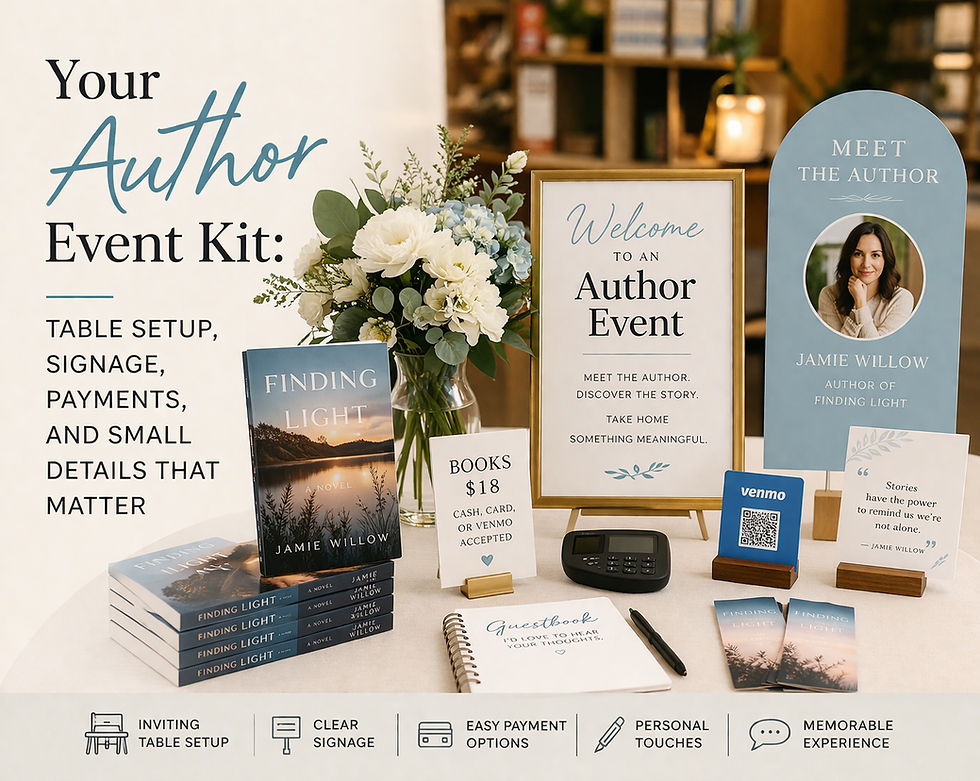
Your Author Event Kit: Table Setup, Signage, Payments, and Small Details That Matter
A good author table doesn’t just look nice. It removes friction. It helps people understand what you write in seconds, it makes buying feel easy, and it keeps you calm behind the table because you’re not improvising all day.
This is the author event kit that actually matters, broken down into practical categories. Think of it as your repeatable system for book fairs, festivals, signings, markets, and conventions.
Start with the table setup that sells
Your table’s job is to do two things at once. Attract the right people and make the decision simple.
Most tables fail because they are too flat. A flat table with stacks of books reads like “I’m selling things,” not “come look at this.” Height and structure create visual interest and make covers visible.
Bring a fitted tablecloth or one that drapes cleanly and reaches near the floor. It instantly makes your setup look professional and lets you hide boxes, bags, and personal items. If you can, bring a second cloth or runner as backup. Events are unpredictable, and one spilled coffee can ruin the mood.
Use simple risers or stands to create levels. Your main goal is face-out covers. A reader can’t fall in love with a cover they can’t see.
If you write a series, make the reading order obvious. You don’t need a big explanation. You need a small sign that says where to start.
If you sell multiple books, choose one featured title to lead the table. People buy faster when you guide them.
Signage that works from three seconds away
Most people won’t stop at your table because your name is on a banner. They stop because they immediately understand what you write and feel like it might be for them.
Your best sign is your genre sign. Big, clear, and readable from several steps away. “Mystery,” “Romantic Fantasy,” “Thriller,” “YA Fantasy,” “Cozy Mystery,” “Historical Fiction.” Choose the language a reader recognizes instantly.
Next is pricing. Pricing should be visible without anyone having to ask. If people have to ask, many simply won’t. They’ll browse, smile, and drift away.
Then your quick hooks. One-liners that describe the book in plain language can do more than any long blurb. Think of a line that feels like a friend recommending it, not a marketing line.
Also consider a small sign that says books are signed. It turns a standard purchase into a souvenir, which matters at events.
If you offer personalization, display that too. Personalization is a quiet sales multiplier. People love the idea of a name written inside the book, and it makes the purchase feel intentional.
Payment setup that keeps you from losing sales
This is where many authors accidentally sabotage a great day. Someone wants to buy, you fumble with tech, and the moment cools off.
Bring at least two ways to take payment. Card is essential at most events. Cash is still worth having. Even if cash only makes up a small percentage, it saves sales you would otherwise lose.
If you use a card reader, test it before the event. Update the app. Charge it fully. Bring the cable. Bring a power bank for your phone. Assume Wi-Fi may be unreliable and know how your system handles offline mode, or have a backup.
Keep your payment station in one consistent place on the table so the flow feels natural. When people see where to pay, buying feels easy.
For cash, bring small bills and coins for change. Keep cash out of sight and secure. Don’t let your table turn into a visible cash pile.
If you use QR codes for payments, make sure they scan quickly and land on the correct screen. A QR code that takes too many steps loses momentum.
The inventory and packing system that saves your brain
Event days are loud, busy, and full of interruptions. You will not have the mental space to track inventory in a complicated way.
Keep it simple. Bring a small notebook or a note on your phone that lists how many copies you started with for each title. When the day ends, you count what’s left. That gives you sales quickly and accurately.
Pack books in clearly labeled boxes. Keep extra stock under the table, but keep your display stacks tidy. A messy pile looks chaotic, and chaos is not inviting.
Bring a couple of bags for customers. It seems small, but it changes buying behavior. When people can carry books comfortably, they buy more. Even basic paper bags feel professional.
If your books can be damaged by weather, bring a plastic bin or protective cover. Even indoor events have load-in and load-out exposure. Rain happens. Wind happens. Accidents happen.
The “small details” kit that prevents event disasters
These are the items authors forget until they desperately need them.
Bring tape, scissors, and a few binder clips. Clips are great for securing tablecloth corners and signs. Tape fixes everything.
Bring pens that work and don’t smudge. Bring a few extras because someone will borrow one and walk away.
Bring sticky notes. They help with quick price signage, sudden adjustments, or leaving notes for yourself.
Bring hand sanitizer. Events involve handshakes, cash, and lots of shared contact.
Bring a lint roller. It sounds ridiculous until you’re wearing black and your tablecloth is shedding.
Bring water and a small snack. A hungry author is not a friendly author, and your energy affects sales more than you think.
Bring a small mirror or basic grooming items if you’re there all day. You don’t need to look perfect, but you do want to look refreshed.
Bring a portable phone charger, always.
If the event is outdoor, bring sun protection and something for wind. Outdoor setups also need tent weights if you’re using a canopy. This is not optional. Wind can ruin your entire day, and it’s a safety issue.
The display items that actually move books
Not everything that looks cute sells books. Choose display items that support the buying decision.
Book stands are worth it. Face-out covers matter.
A simple genre sign is worth it.
A small “start here” sign for a series is worth it.
A clear price sign is worth it.
A small bundle sign is worth it if you offer bundles.
Everything else is optional. Don’t over-decorate. Books should be the visual focus. Your setup should feel like a mini bookstore, not a craft booth.
The interaction flow that makes selling feel natural
Selling books doesn’t have to feel awkward. The easiest approach is to be present, warm, and low-pressure.
When someone stops, you can greet them and then give them a small opening. A simple “Hi, feel free to pick anything up” works. If they linger on a cover, that’s your moment to offer a quick line about the book.
Keep it short. If they want more, they’ll ask. If you talk too much too soon, people back away, even if they were interested.
When someone buys, make it special without making it slow. Ask if they’d like it signed, and if they want a name in it. That moment is your advantage over online sales. It’s personal.
After the event, pack down like a pro
At the end of the day, your future self will thank you if you pack with some structure.
Count remaining inventory before you start chatting and drifting into post-event haze. Take a quick note of what sold best and what questions people asked. Those questions tell you what your signage and pitch should say next time.
Store your signs and supplies in the same bag every time. You want your event kit to become something you can grab without thinking.
The mindset that makes the kit work
The goal of an author event kit is not to carry more stuff. It’s to carry fewer surprises.
When your table is readable, your payments are smooth, and your small details are handled, you get to focus on what actually matters. Connecting with readers. Making the experience pleasant. Turning curiosity into a purchase and a future fan.
Once you build this kit, you’ll reuse it again and again. And every event gets easier, calmer, and more profitable because you’re no longer reinventing the wheel.


Comments