


The Series Bible Every Author Needs: Keeping Characters, Timelines, and Story Worlds Consistent

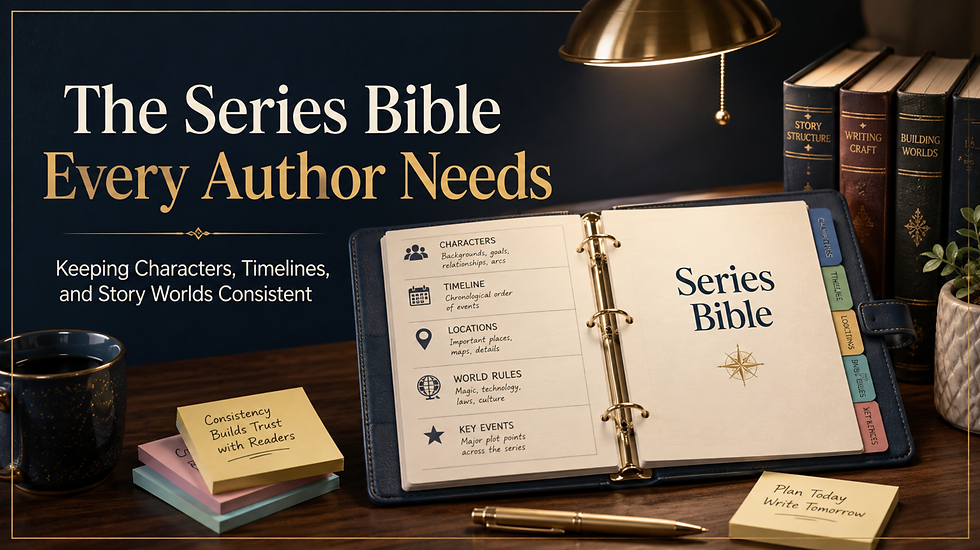
The Series Bible Every Author Needs
Writing a standalone novel requires careful planning. Writing a series requires something more: a reliable system for remembering every detail you have already introduced.
A character’s eye colour, a town’s layout, the date of an important event, or the rules of a fictional world may seem easy to remember while drafting the first book. By Book Three, those details can become difficult to track.
This is where a series bible becomes essential.
A series bible is a central reference document containing the important facts, rules, timelines, and decisions connected to your books. It helps prevent continuity errors, saves time during drafting, and keeps the world of the series consistent.
Why Continuity Matters
Readers pay attention to details, especially when they are invested in a series.
They notice when a character’s age changes without explanation, when a location suddenly has a different layout, or when a rule established in an earlier book is ignored later.
Small inconsistencies may not destroy a story, but they can weaken the reader’s trust. Larger mistakes can create confusion or make important plot developments feel unconvincing.
A series bible helps you avoid problems such as:
Changing physical descriptions
Conflicting dates and ages
Forgotten relationships
Repeated character names
Inconsistent magical or technological rules
Timeline errors
Plot points that contradict earlier books
Characters knowing information they should not have
The longer the series becomes, the more useful the document will be.
Start With Character Profiles
Each recurring character should have a dedicated profile.
You do not need to record every detail immediately. Begin with the information that could affect future scenes.
Include:
Full name and nicknames
Age and date of birth
Physical appearance
Occupation
Family members
Important relationships
Personality traits
Fears and motivations
Skills and weaknesses
Speech patterns
Habits and mannerisms
Secrets
Major events that affect them
First appearance in the series
It is also helpful to record details that seem minor but could become noticeable later, such as whether a character is left-handed, wears glasses, has a scar, avoids certain foods, or drives a specific car.
For main characters, include their emotional development across each book. Note what they believe at the beginning, what they experience, and how they change by the end.
This helps prevent characters from repeating the same emotional arc without progress.
Build a Clear Timeline
Series timelines can become complicated quickly.
Even a story set over a few weeks may involve birthdays, travel time, school terms, holidays, investigations, pregnancies, court dates, or historical events.
Create a timeline for each book and one master timeline for the full series.
Record:
The date each book begins and ends
Major events
Character ages at key moments
Travel periods
Time gaps between books
Flashbacks
Deaths, births, weddings, and separations
When characters meet
When secrets are discovered
Important events that happen off the page
A simple spreadsheet can work well because dates and events are easy to sort. Some authors prefer a calendar, table, or visual timeline.
The format matters less than clarity.
Whenever you revise the story, update the timeline. Moving one event may affect several later scenes.
Map Important Locations
Readers build mental pictures of places. Once you describe a house, village, school, spaceship, or fantasy kingdom, they expect it to remain consistent.
Create a section for each major location.
Include:
Name
Type of location
General appearance
Important rooms or areas
Nearby landmarks
Travel distance from other places
Weather or climate
Who lives or works there
Events that happen there
Changes made during the series
For frequently used locations, a basic map or floor plan can prevent mistakes.
For example, if a character hears a conversation from the kitchen, the room layout should make that possible. If two towns are several hours apart in Book One, characters should not travel between them in twenty minutes in Book Two.
These details support believable storytelling.
Record the Rules of Your World
Fantasy, science fiction, paranormal fiction, dystopian fiction, and complex thrillers often depend on specific systems.
These may include magic, technology, government, religion, crime organisations, supernatural abilities, or social rules.
Write down exactly how each system works.
Ask:
What is possible?
What is impossible?
What are the limits?
What are the costs or consequences?
Who understands the system?
Who controls it?
Can the rules change?
What exceptions exist?
What has already been revealed to readers?
Rules create tension because characters must work within them.
If the rules change whenever the plot needs an easy solution, readers may feel that the story is unfair. Consistent limitations make victories, discoveries, and sacrifices more meaningful.
Track What Each Character Knows
Knowledge continuity is often overlooked.
A character should not refer to information they have never learned. Similarly, they should not act surprised by something they discovered in an earlier book.
Create a record of major secrets, clues, and revelations.
Note:
Who knows the information
When they learn it
How they learn it
Whether the information is true
Who believes a false version
When the reader learns it
This is especially important in mysteries, thrillers, romances, and stories with multiple points of view.
It can also help you plan suspense. You can clearly see which characters know more than the reader and which characters are working with incomplete information.
Include Book-by-Book Summaries
Add a brief summary of every completed book.
Focus on the details that may matter later:
Main conflict
Important discoveries
Character changes
New relationships
Broken relationships
Deaths and injuries
Unresolved questions
Villains or threats still active
Promises made to the reader
Objects or locations that may return
This makes it easier to refresh your memory before drafting the next instalment.
It is also useful when working with editors, proofreaders, co-authors, designers, or marketing teams who need to understand the series.
Keep a List of Unresolved Threads
Every series creates open questions.
Some are intentional. Others are small details that may later become useful.
Maintain a section for unresolved threads, including:
Missing characters
Unexplained events
Hidden identities
Unfinished conflicts
Foreshadowing
Family secrets
Unanswered questions
Objects with unexplained importance
Promises that have not yet been fulfilled
Review this list before outlining each new book.
You may decide to resolve a thread, develop it further, or remove it during revisions. The important thing is to avoid forgetting it.
Update the Bible While You Write
A series bible should not be created once and then ignored.
Update it whenever you introduce a new character, reveal a secret, change a location, establish a rule, or alter the timeline.
Many authors wait until they finish a draft and then discover that they cannot remember which details are final. Updating the document as you write is usually faster.
Mark uncertain details clearly. For example, label them as “draft decision” until they are confirmed.
It may also help to keep deleted ideas in a separate section. This prevents you from accidentally reusing information that was removed from the final manuscript.
Choose a System You Will Actually Use
Your series bible can be a document, spreadsheet, notebook, database, or collection of linked notes.
It does not need to be visually impressive. It needs to be searchable, organised, and easy to update.
Use clear headings and consistent categories. Add page numbers or chapter references where useful.
A simple system that you maintain is far more valuable than a complicated system you avoid opening.
Final Thoughts
A series bible protects the consistency of your characters, timeline, locations, and story world.
It reduces continuity errors, supports stronger planning, and makes each new book easier to write. It also helps ensure that character development continues naturally rather than restarting with every instalment.
The best time to create a series bible is before the details become difficult to manage. Start with the information you already know, update it regularly, and allow it to grow alongside the series.
Your readers may never see the document, but they will notice the consistency it creates.


Comments